
Lay the track
Grow a network, hex by hex.
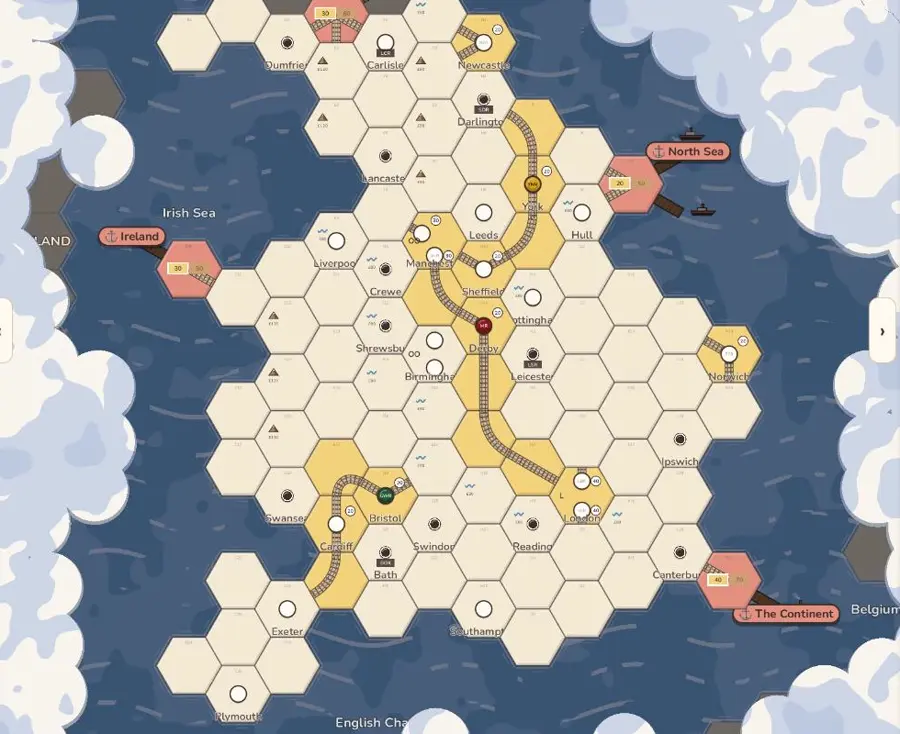
Every railway starts from its home city. Lay tiles to reach new towns and ports, then upgrade them as the game moves on: yellow track turns green, then brown, and the cities grow with it.
Run the trains
Every run pays out, or builds up.
Your trains run the best routes on their own, and you choose: pay the money out to shareholders, or keep it for the next, bigger train. Buy too slowly and your old engines rust away.
Play the market
You're an investor, not a railway.
Buy shares, start companies and run them as president. Ride along on a rival's success, or sell at just the right moment. When the bank breaks, the richest player wins.
New to 18xx?
It teaches you as you play.
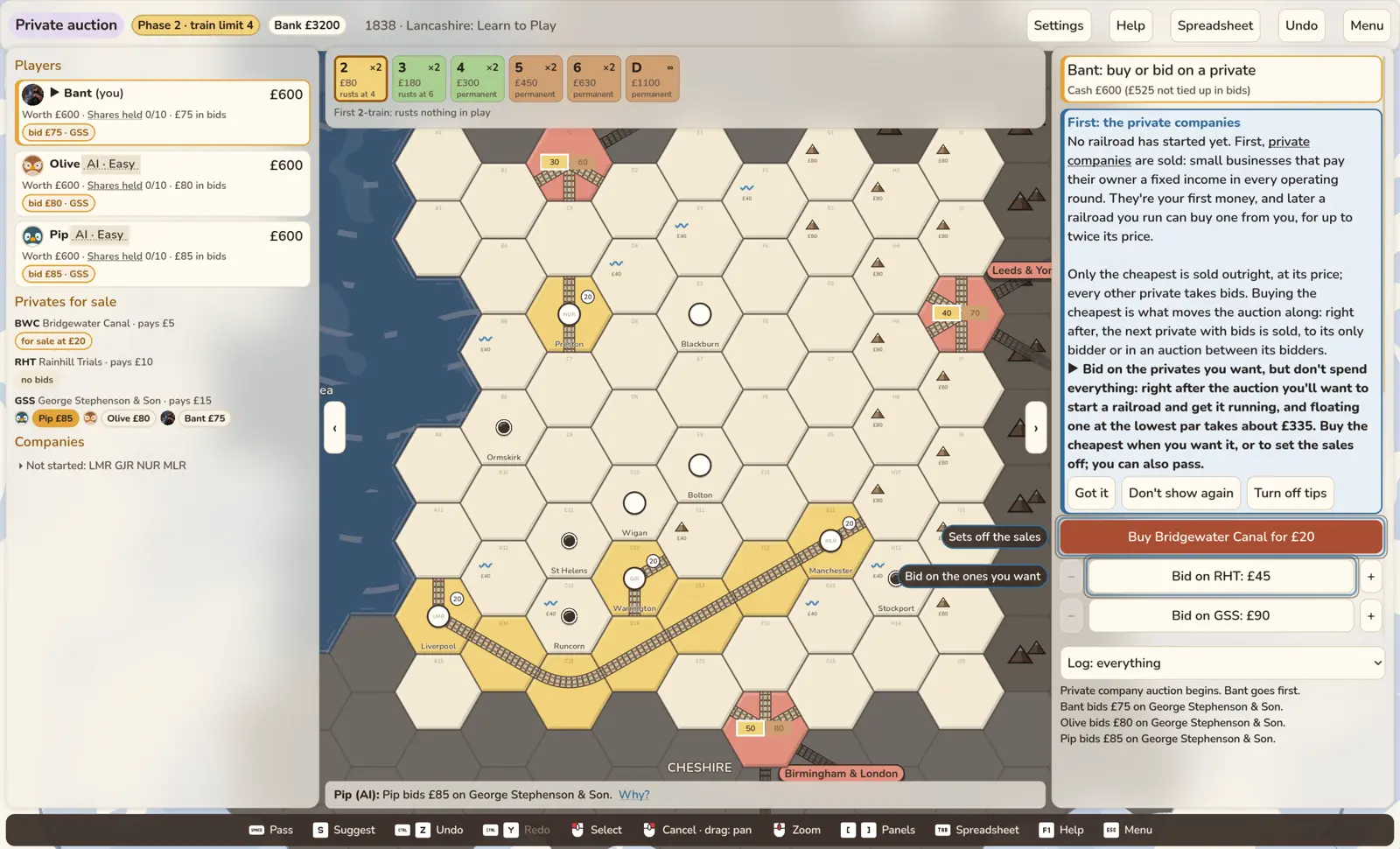
A short first game walks you through every round. Coach cards explain each new situation the first time it comes up, the AI tells you why it made each move, and Suggest proposes a good move and why. Undo is always there.
Twelve maps to start
From the Pampas to the Alps.
Each map is rated Basic, Advanced or Pro by how far it strays from the classic rules: loans, minor companies, mergers, short selling and more await when you want them.
- 1845 England and WalesRailway ManiaBasic
- 1872 SwitzerlandAlpine EngineeringBasic
- 1865 Right-Bank UkraineThe Imperial Fault LineBasic
- 1886 The Highveld and NatalThe Gold ReefBasic
- 1869 The American WestRails to the PacificAdvanced
- 1887 The PampasThe Agro-Export BoomAdvanced
- 1859 Northern IndiaThe Grand TrunkAdvanced
- 1872 Central JapanMeiji RailwaysAdvanced
- 1847 The RuhrCoal and SteelAdvanced
- 1841 South WalesValleys and DocksAdvanced
- 1857 DenmarkJutland and the Islands · for twoAdvanced
- 1843 BelgiumCoal, Credit and SteelPro
Mix and match
More than twenty rules to switch on.
Every map is the classic game at heart. On top of it, a map can turn on any of these, and the map editor lets you pick your own mix.
Openings
- Private draftDeal the private companies out from a hand of cards instead of auctioning them.
- Privates auctioned in turnPlayers take turns putting privates up for auction, with seed money from the bank.
- Bid boxesMinors, concessions and privates come up for bids, a few at a time, all game long.
- Founding auctionsRailways are started by auction; the winning bid becomes their treasury.
Companies
- Minor companiesSmall one-owner railways that larger ones can take over.
- Growing companiesStart with 2 shares and grow to 5 or 10, selling new shares for money.
- Mergers and acquisitionsJoin two companies, or sell one at auction to another.
- Share issuingCompanies sell their own shares to raise money, and buy them back later.
- DestinationsA railway's far-off goal: reach it to earn its value again on every run.
Money
- Loans and interestBorrow for that next train, while every loan raises the rate for everyone.
- Short sellingBet against a company, and pay its dividends while you do.
- LiquidationA company that can't pay its way is wound up and its assets auctioned.
- ReceivershipA bankrupt president's companies carry on without them.
- Player loansPresidents borrow from the bank instead of going bankrupt.
- Half dividendsPay shareholders half the run and keep the rest for trains.
- Bigger dividends, bigger movesShare prices jump further the more a company pays.
Map and trains
- Through routesJoin off-boards on opposite sides of the map for a bonus.
- Mines, bridges and mailMarkers on the map that pay the companies using them.
- Trains that run differentlyExpress, local and double-value trains, and ones that ride along with others.
- Train exportsTrains leave the depot every round, so the phases march on.
- Private powersExtra tile lays, stations, tax havens, train discounts and more.
Make your own maps
Paint a map, then play it.
The map editor turns hexes into a railway game: paint land, towns, cities, hills and rivers, add railways, privates and their powers, and pick the rules. Check it, play it against the AI, and share it on the Steam Workshop.
Play your way
Everything a game night needs.
- 🤖
AI opponents
Easy, Medium or Hard, and every move comes with a reason.
- 🌐
Online with friends
Invite Steam friends to your table, or pass one screen around.
- 🗺️
Map editor
Paint your own map, add railways and rules, and share it on the Steam Workshop.
- ☕
Cozy by design
Soft colours, gentle music, and the game does all the arithmetic.
- 🎮
Steam Deck ready
Keyboard and mouse on desktop; on the Deck, the controls map to the same shortcuts.
- 🗣️
Four languages
English, Español, Deutsch and Українська.
Whole games in seconds
Watch a game grow.
Four AI players, from the first tile to the last train, sped up.
See it in motion